Named Pipes Under Attack: Securing Windows Interprocess Communication
ThreatLocker publishes guidance on mitigating risks from weakly protected Windows named pipes
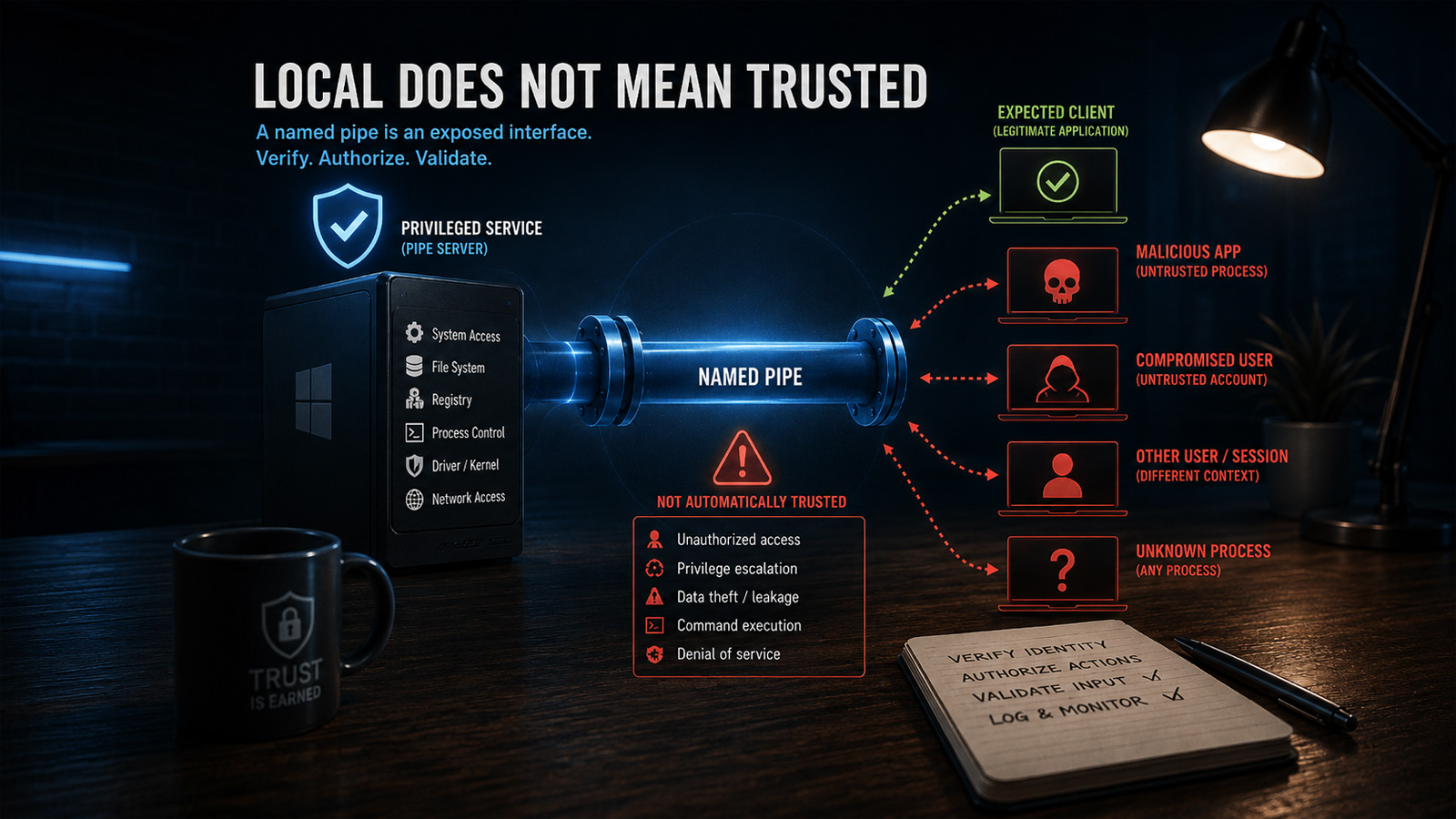
Key Takeaways
- Windows named pipes are susceptible to exploitation when access controls are weak.
- ThreatLocker published guidance on securing named-pipe communication without referencing a specific CVE.
- Reported risk includes unauthorized interprocess communication and potential privilege escalation.
- Defensive recommendations include endpoint verification, command authorization, strict input validation, and narrowly scoped privileges.
- No active exploits in the wild are confirmed in the source summary.
Quick answers
- What happened?
- A recent advisory from ThreatLocker, reported by BleepingComputer, highlights that Windows named pipes—used for interprocess communication—can expose privileged services to untrusted processes when access controls are weak. The guidance outlines defensive measures including endpoint verification, command authorization, strict input validation, and narrowly scoped privileges to reduce exploitation risk.
- Which products are affected?
- Windows Named Pipes
- What should defenders do?
- Implement endpoint verification, command authorization, strict input validation, and narrowly scoped privileges for named-pipe endpoints. Review access control lists (ACLs) and restrict pipe permissions to trusted processes only.
Windows named pipes provide a fast mechanism for interprocess communication on Windows systems, but improper access controls can allow untrusted processes to interact with privileged services. According to a report from BleepingComputer, ThreatLocker has published guidance addressing the security implications of poorly secured named pipes. The advisory notes that threat actors may exploit weakly protected pipes for unauthorized interprocess communication or privilege escalation. ThreatLocker recommends implementing endpoint verification, command authorization, strict input validation, and narrowly scoped privileges as defensive best practices. The report does not cite a specific CVE or confirm active exploits in the wild, but emphasizes that misconfigured access controls represent a significant risk vector. Organizations using Windows named pipes for internal service communication are advised to review and tighten access controls in line with the recommended mitigations.
Security Details
Windows named pipes facilitate interprocess communication; weak access controls may expose privileged services to untrusted processes. ThreatLocker recommends endpoint verification, command authorization, strict input validation, and narrowly scoped privileges as mitigations. No specific CVE or confirmed active exploit cited.
Affected products
Windows Named Pipes
Mitigation
Implement endpoint verification, command authorization, strict input validation, and narrowly scoped privileges for named-pipe endpoints. Review access control lists (ACLs) and restrict pipe permissions to trusted processes only.
Sources
BleepingComputer
Named Pipes Under Attack: Securing Windows Interprocess Communication
Aug 22, 2026 · 13:00
Original link
Related Security News

CISO-CMO Alliance Emerges as Strategic Imperative for Cybersecurity-Brand Reputation Alignment
A recent Dark Reading analysis explores how organizations can strengthen governance by establishing regular touchpoints and joint crisis communications plans between Chief Information Security Officers and Chief Marketing Officers. The article emphasizes that translating security risks into brand impact is essential for maintaining stakeholder trust.

_Dzmitry_Skazau_Alamy.jpg?width=720&quality=80&disable=upscale)